
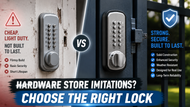
Why Our Mech-Digi Range Is Better Than Hardware Store Imitations
Posted by Mat Steele on 9th Jul 2026

Two keypad locks can look nearly identical from the front. The difference is everything you cannot see — and everything that happens after year one.
At first glance, many mechanical digital locks look similar: buttons, a handle or knob, keyless access to a door or gate. That makes it tempting to compare on price alone — a cheap big box retailer keypad lock looks like it does the same job as a professional-grade lock from Lockwood, Borg or Carbine. The real difference is usually hidden: in the latch, the finish, the fixing strength, the coding chamber, the weather resistance, and the suitability for the actual door or gate.
This guide covers:
- Why two similar-looking locks behave completely differently after installation
- What is inside a quality coding chamber — and what the copies leave out
- Gates, corrosion, commercial traffic and code changing: where the gap shows
- The retrofit and spare-parts ecosystem the imitations simply do not have
- An honest answer on where a cheap lock is still perfectly fine
If you are new to this type of lock, start with the main guide on how mechanical digital locks work and come back.
The Simple Answer
Big box retailer mechanical keypad locks can be suitable for some light-duty internal applications — and we say so honestly further down. But they are usually the wrong choice for exposed gates, coastal properties, high-use commercial doors, strata access, body corporate areas, schools, workshops, warehouses, or any installation where reliability really matters.
And we can say that with some authority, because this is not a guess — it is fifty years of evidence. Terry's has been fitting and servicing locks on the Gold Coast since 1975. We know what we are talking about. We know what works, and we know what lasts, because we are the ones who installed it, and we are the ones called back years later when something does not.


Looks Can Be Misleading
Two mechanical digital locks can look almost identical from the front. Both have a keypad, both use a code, both claim to suit doors or gates. The front of the lock does not tell the story — these questions do:
- What is the internal mechanism made from, and how strong is the latch or bolt?
- Is the lock genuinely designed for external use — and will the finish handle coastal air?
- Is it actually suitable for a gate, and is the backset right for the door or gate?
- Can spare parts be sourced, and can the code be changed easily?
- Is it designed for high-traffic commercial use?
These details decide everything once the lock is installed. For the brand-by-brand version of this comparison, see Lockwood vs Borg vs Carbine.
Build Quality: The Coding Chamber Is Where Corners Get Cut
A mechanical digital lock is a mechanical device. Every code entry presses buttons, turns a lever and retracts a latch — the internal parts do work every single time. On a low-use internal cupboard that hardly matters; on a staff door, shared gate, school or body corporate access point, the lock works many times every day.
Here is what most buyers never see. Inside the keypad sits the coding chamber: one tumbler per button, which is why these locks accept the code in any order — 1346 and 6431 both open the same lock. That design means the whole security and feel of the lock lives in the machining of those tumblers, the button return springs, and the chamber material. Quality brands machine the chamber in stainless steel with hardened buttons; imitations copy the keypad face and cut the corner exactly where it cannot be seen. The full mechanism is explained in why the code works in any order.

The Latch Is Just as Important as the Keypad
Many people focus on the keypad, but the latch or bolt is what actually secures the door or gate. A poor-quality latch makes the lock feel rough, fail to latch properly, bind against the strike, or wear prematurely — and on gates it gets worse, because gates move, sag, vibrate and shift over time.
Our range includes proper latch options for the application: tubular, short backset, mortice, deadlatch, gate-specific and heavy-duty commercial arrangements. The decision itself is explained in latch vs bolt mechanical digital locks.

Gates Are Not Standard Doors
This is one of the biggest reasons we are careful with mechanical digital locks. A gate is not an internal timber door — gates face weather, wind, movement, sagging, vibration, narrow stiles, uneven gaps and harsh outdoor conditions:
- Some gates have narrow 50 x 50mm stiles with no room for a 60mm tubular latch — what actually fits a narrow stile
- Some gates can be reached over or through, and need double-sided keypad control — the single-sided problem
- Some gates move too much for certain latch types — our magnetic latch installs run a real-world 50% revisit rate, which is exactly the kind of field data an imitation product never comes with
- Some gates require marine-grade corrosion resistance from day one
Weather and Corrosion Resistance Matter
On the Gold Coast, weather exposure is not a minor detail. Rain, humidity, salt air, pool chemicals and coastal conditions destroy the wrong lock quickly — a cheaper lock may look fine on installation day and corrode from the inside within a couple of seasons.
The professional brands publish their numbers: Borg's Marine Grade Pro coating is salt spray tested to 1,000 hours, and Carbine publishes its 240-hour figure in writing — the honest comparison, with what the hours do and do not promise, is in corrosion resistance honestly compared and salt spray hours compared. An imitation lock typically publishes nothing, because there is nothing to publish.

Commercial Use Needs Commercial Hardware
A home lock might operate a few times a day; a commercial lock is used constantly by staff, trades, cleaners, tenants and visitors. That traffic level changes the requirements: stronger internals, better lever and spindle operation, more durable buttons, heavy-duty latch compatibility, key override options, fire door certification where applicable, and managed free passage features.
The professional ranges are built and rated for it — cycle testing is the number to ask for, explained in what cycle ratings mean — while the full commercial picture, from fire certification to exit-path lever rules, is in heavy duty commercial mechanical digital locks. Choosing a high-traffic commercial lock on price alone is a false economy.
Code Changing Should Be Practical
Another major difference is how the code is changed. Some locks require removal from the door and internal tumbler rearrangement — workable at home, frustrating for managed properties, rentals, strata and commercial sites where codes change often.
Professional-grade ranges offer better options, including on-door systems like Borg's Easicode Pro that change the code in about thirty seconds without touching a screw — all three brands' methods are compared in three code change methods compared. And if shared access is the reason codes change, check whether passage or holdback mode suits the site first.
The Retrofit Ecosystem: What Imitations Cannot Offer
Here is a difference that only a real product ecosystem makes possible. A quality mechanical digital lock does not always have to replace everything on the door — often the smartest job is fitting a keypad-only unit to the quality hardware already there.
The most common version we do: an existing door with good furniture — a Lockwood 4905-style mortice setup, or older commercial lever hardware — gets the Borg BL4401K keypad-only unit fitted to the outside, adding code access while the existing latch, internal handle and door prep all stay. Where the door needs an adaptor between keypad and existing case, the Borg 3582 adaptor kit for 2000 and 4000 series keypads is the bridge — a purpose-made part that exists precisely because Borg builds a system, not a sealed disposable unit.

Spare Parts and Support Matter
One of the underrated benefits of buying a proper mechanical digital lock is everything around the lock. Established brands mean spare latches, strikes, spindles, code components, replacement parts, documentation and installation advice — for years after purchase. With imitation products, once something breaks or the wrong latch was supplied, the answer is usually a whole new lock.
The ecosystem goes down to details most people never think about: when a new lock replaces an old one and leaves screw holes or marks on the door, Borg sells the scar plates made to suit its 2000 and 4000 series to cover them cleanly. What scar plates are and when you need one — and which brands make them — has its own guide.
Our Range Is Curated, Not Random
We do not list every mechanical digital lock we can find. The range is selected around real applications — gates, narrow stiles, exposed outdoor installs, high-traffic commercial doors, internal offices, storerooms, fire door requirements, coastal areas — guided by which brand suits which job, and anchored by proven products like the Lockwood 530DX, the workhorse we fit more than any other on commercial doors.
The curation shows most clearly in replacement work. We regularly replace old commercial keypad locks — Unican-era units, early Carbines, older Lockwood digitals — and the failure is almost never the mechanism wearing out; it is a lock that was never suited to its job. So we do not replace like-for-like: we replace with the model that suits the use case, which is the entire philosophy of the range — the same thinking behind the brand profiles in our Buyer's Guide. The pattern is described in when heavy duty is worth it.
Where a Cheap Lock May Still Be Okay
Honesty cuts both ways: not every cheaper lock is useless. A budget mechanical keypad lock may be perfectly acceptable where security expectations are low, weather exposure is zero, and early replacement would not be a major issue:
- Low-use internal cupboard doors and basic internal storerooms
- Temporary low-security access
- Situations where weather and heavy use are simply not factors
That is a very different situation from a gate, commercial door, external access point or shared entry where people expect the lock to perform reliably for years.
What Even the Good Ones Will Not Do
The same honesty applies to our own shelves. Professional-grade mechanical digital locks are reliable, battery-free and built to last — but they are not smart locks, and quality does not change the category's limits.

One more honest point: over years of use the buttons in the code wear and discolour, which narrows the guesswork for anyone paying attention. Changing the code periodically is worth doing for this reason alone — and hardened stainless buttons resist that wear far longer than the soft materials on budget locks, which is one more place the quality gap shows.
None of these are faults. They are the trade you accept for a lock that never needs a battery, never loses connection and keeps working through a power outage. If you need per-person access or an audit trail, an electronic lock is the better tool — the full honest comparison is in what mechanical digital locks will not do.
Quick Comparison — and the Real Difference
| Feature | Hardware store imitation | Professional range |
|---|---|---|
| Best use | Light-duty internal use | Doors, gates, commercial sites, external and specialist applications |
| Latch options | Often limited | Tubular, mortice, gate-specific, short backset and heavy-duty options |
| Weather resistance | Often limited or unpublished | External and marine-grade options with published salt spray testing |
| Commercial use | Rarely suited to high traffic | Cycle-tested heavy-duty and fire-certified models available |
| Retrofit & spares | Whole lock or nothing | Keypad-only units, adaptor kits, scar plates and parts support |
| Advice before buying | Often limited | Application-specific recommendation based on door, gate and usage |
So why is our range better? Because we stock trusted brands with proven real-world performance; we offer gate-specific, commercial-grade, marine-grade and retrofit options; we consider latch type, backset, handing and installation suitability before recommending anything; and we would rather recommend the right lock than sell the wrong one quickly.
That is the real difference. It is not about selling a keypad lock — it is about choosing the correct mechanical digital lock for the job.
Related Guides
The category explained from the coding chamber out — battery-free keyless entry.
The three brands compared on strength, corrosion and code changing.
Cycle ratings, fire certification, exit paths and DDA levers explained.
How the two locking formats differ, and which suits your door or gate.
Realistic lifespans, cycle ratings and what shortens them.
Covering old lock marks cleanly — what they are and when you need one.
Not Sure Which Mechanical Digital Lock to Choose?
Email a few photos to contact@terrys.team with your name and phone number, and we will recommend a lock that actually suits your door, gate or commercial application — before you buy.
Ask an Expert- A photo of the front of your door or gate
- A photo of the edge showing the existing latch or lock
- Your approximate door or gate thickness and backset, if known
- Whether it is internal, external, coastal, commercial or high traffic
- How often the lock is likely to be used each day
This helps us recommend the correct lock before you buy.
Disclaimer: This article is general information only. The correct mechanical digital lock depends on your door type, gate design, latch preparation, backset, environment, usage level, security expectations and installation conditions. Always confirm suitability before purchasing or installing hardware.