
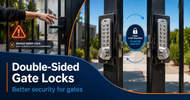
Why Double-Sided Digital Mechanical Locks Are a Smart Choice for Gates
Posted by Mat Steele on 12th Jun 2026

A keypad on the outside looks secure — but if someone can reach the inside handle, the lock is only doing half the job.
Digital mechanical locks are popular on gates because they are simple, battery-free and easy to use — enter the correct code, turn the handle, and the lock opens. But gates create a security challenge doors do not: if the inside handle can be reached from outside the gate, the keypad may not be doing as much as you think.
This guide covers:
- Why single-sided gate locks get bypassed, and where it happens most
- Clear perspex panels — what they fix, and what they do not
- What a double-sided (back-to-back keypad) lock is, and its real benefits
- When a double-sided lock is the right call — and the one place it is not
If you are new to this style of lock, start with the main guide on how mechanical digital locks work and come back.
The Problem With Single-Sided Gate Locks
A single-sided digital mechanical lock usually has a keypad on the outside and a simple knob, lever or turn handle on the inside. That works well on many doors — but gates are different.
If the gate is low enough to reach over, someone can reach through the bars, or someone can simply jump over, they can turn the inside handle and open the gate without ever touching the keypad. The outside looks secure; the gate opens in two seconds from the other side.


Where This Commonly Happens
The reach-over problem is most common wherever the inside handle is exposed, easy to reach, or protected only by open bars:
- Side access gates and low pedestrian gates
- Gates with open bars or gaps
- Pool equipment gates, bin area gates and restricted outdoor areas
- Staff-only and commercial side gates
What About Clear Perspex Panels?
On gates with open bars, a sheet of clear perspex fixed across the gap near the lock is a common fix for the reach-through path specifically. It stops a hand passing between the bars to the inside handle.
It only solves that one problem. Perspex does nothing for reach-over or jump-over — if the gate is low enough to climb or reach over the top, a clear panel next to the lock changes nothing. It is the right fix only when reach-through is genuinely the only risk on that gate.


Done well, a perspex panel is meant to be inconspicuous — the yellow dashed outline on the left marks where it runs behind the timber slats near the lock. The close-up on the right shows the same panel without a marker: look closely at the slats either side of the lock body and you can just make out the edge and its fixing screws.
Where it applies, perspex is an affordable option that keeps the open, airy look of a bar gate. The trade-off is durability: it can discolour and craze or crack with UV and weather exposure over time, so treat it as a working panel that may need replacing down the track, not a permanent one.
What Is a Double-Sided Digital Mechanical Lock?
A double-sided digital mechanical lock — also called a back-to-back keypad lock — has a keypad on both sides of the gate. Instead of only requiring a code to enter, it requires a code to enter and exit. That removes the reach-over-and-turn problem entirely, because there is no free-exit handle to operate.

Code required from the outside, but the inside has a free-turn knob, lever or handle.

Code required from both sides, preventing reach-over or reach-through access.
Two purpose-built examples from the range: the Borg BL4441 back-to-back gate lock and the Borg BL3430 back-to-back forend fixing gate lock — both Marine Grade Pro with on-door code changing.
The Main Benefits
The gate stays controlled in both directions. Nobody can reach over, reach through, or walk around and turn a handle — and the internal build quality of the professional range keeps both keypads reliable outdoors.
No batteries, WiFi, Bluetooth, apps or wiring — a practical fit for outdoor gates a long way from power.
Codes go to approved users without cutting keys, and can be updated without replacing cylinders when access changes.
Most gate security failures are simple physical bypass. A keypad both sides removes the easiest one.
When Should You Consider a Double-Sided Keypad Lock?
A double-sided digital mechanical gate lock is worth considering when:
- The gate is low enough to reach over or climb over, has open bars or gaps to reach through, or is otherwise easy to jump
- The inside handle can be reached from outside
- You want keyless access from both sides
- The gate does not form part of a required exit path
- You want a simple, non-electronic solution

 Not Allowed On Required Exit Paths
Double-sided keypad locks are not suitable everywhere — and this is the hard exception. If a gate forms part of a required exit, fire escape path, emergency evacuation route or any other required path of travel, the rule is simple: no keypad on the egress side. People must be able to exit without needing a code, a key, or any special knowledge.

Under NCC 2022 D3D26, a door in a required exit — or in the path of travel to one — must also be readily openable without a key from the egress side, by a single downward action or a single pushing action. That rules out knobs too, since they need a grasp-and-twist rather than a single action — a lever model is the correct fit once the keypad itself is off the table. This is exactly what "BCA compliant lever" means on the Carbine CDL7200 heavy duty range, and why Borg offers the BL5401 flat-bar DDA lever built to AS 1428.1.
This matters most for commercial buildings, unit complexes, shared buildings, fire exits, and any gate that may form part of an evacuation plan. If there is any doubt, the gate should be assessed before choosing the lock. Where free egress is required but both-sides code control is wanted on a non-exit commercial gate nearby, the Carbine CDL7200 dual keypad with dual BCA levers shows how the heavy duty end of the market handles the lever requirement on both faces.
Related Guides
The category explained from the coding chamber out — battery-free keyless entry.
How the two locking formats differ, and which suits your door or gate.
The four workable answers for narrow aluminium gate frames.
The alignment problem, the real revisit rate, and what we fit instead.
What each function does, when to use them, and the one hard exclusion.
Which locks suit gates, aluminium frames, narrow stiles and screen doors.
Need Help Choosing the Right Gate Lock?
Email a few photos to contact@terrys.team with your name and phone number, and we will work out whether a double-sided keypad lock is right for your gate — or when a different type of hardware is required.
Ask an Expert- A photo of the gate from both sides
- A photo of the edge showing the existing latch or lock
- The approximate stile width
- Whether the gate is part of a required exit path
- Whether the gate is coastal, poolside, fully exposed or sheltered
This helps us recommend the correct gate lock before you buy.
Disclaimer: This article is general information only. The correct gate lock depends on your gate design, existing hardware and intended use. Exit path requirements are regulated; always confirm compliance with the relevant authority before purchasing or installing hardware.