Gate Post Too Narrow for a 60mm Latch?
Posted by Mat Steele on 9th Jul 2026

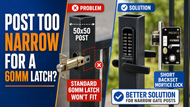
A 50 x 50mm gate frame will not take a standard 60mm tubular latch — but you still have four good options.
You have picked a mechanical digital lock you like, ordered it, and when it arrives the latch will not go into the gate. The keypad sits fine. The latch is simply too long for the section of frame you are fitting it into.
This is one of the most common gate problems we deal with, and the lock is almost never the issue. It is the size of the vertical member you are fitting it into — and once you have that measurement, the choice becomes straightforward.
This guide covers:
- Why a 60mm backset latch cannot physically fit a 50 x 50mm frame
- The two gate frame size groups that matter, and how to tell which one you have
- Four options for a narrow frame — short backset latch, forend fixing, a mounting box, or a creative workshop solution
- What opens up once you have a wide stile to work with
- What to measure before you order anything
If you have not measured a backset before, start with how to measure your lock backset and come back.
Measure the Stile, Not the Post
Almost everybody calls it the gate post, ourselves included. It is worth being precise for one paragraph, because it changes what you measure.

- The post is the fixed upright the gate hangs on or latches against. The strike plate goes here.
- The stile is the vertical member of the gate leaf itself — the part that swings. The lock body, keypad and latch all go here.
When someone tells us their gate post is too narrow, what they almost always mean is that the stile is too narrow. That is the measurement that decides which lock you can use.

What Backset Actually Means
Backset is the distance from the edge of the stile to the centre of the spindle — the point the handle turns on. It is not the length of the latch, and it is not the thickness of the gate.
In Australia, 60mm is the default backset for tubular latches, and most mechanical digital locks ship with a 60mm latch as standard. On a timber door with a 90mm or wider stile that works perfectly.
On a 50 x 50mm gate frame it does not work at all. A 60mm backset would put the spindle centre 10mm past the far face of the section, where there is no material. This is not a tight fit that patience will solve — it is geometrically impossible.

For the full picture, see Chapter 2 of the Buyer's Guide on backset and stile width, or the blog on what happens when the backset is wrong.
Wide or Narrow Stile?
Gate frames come in every size a fabricator has felt like cutting, but for lock selection they fall into two groups.
Narrow stile — 50 x 50mm or 65 x 65mm
Typically aluminium, and by far the most common thing we see on Gold Coast side gates and courtyard gates. A standard 60mm latch will not fit either size. You have four ways forward, all covered below.
 Wide stile — 100 x 50mm, wide timber, or fabricated to suit
Enough material to take a standard 60mm tubular latch. If this is what you have, the whole mechanical digital range is open to you and this becomes a straightforward choice rather than a compatibility exercise.

Narrow Stile Gates: 50 x 50mm and 65 x 65mm

This is the situation that brings most people to this page. The gate is aluminium, the frame is a square hollow section, and the latch that came with the lock is far too long.
 Option 1 — a short backset mortice latch
The simplest answer. A 28mm backset mortice latch sits well inside a 50 x 50mm section with room to spare, and comfortably inside 65 x 65mm. The keypad and handle look and work exactly as they would on a door — only the latch behind them is different.
There are two ways to get there. The first is to buy a lock already supplied with a short backset latch. The Borg BL2702SCECP with a 28mm mortice latch comes as a complete package with Easicode Pro on-door code changing, key override and a holdback function. If you do not need the key override, the Borg BL2002SC knob keypad with 28mm latch is the simpler package, and the Borg BL2202SC adds a holdback function for propping the gate open.
The second is to add a short backset latch to a lock you already want. Many 60mm backset mechanical digital products can be purchased with a compatible short backset latch added to the basket, which opens up a far wider choice of keypad and handle styles. For the Borg 2000 series that means the 28mm left hand latch or the 28mm right hand latch.

A 28mm backset short mortice latch. Note the L.H. marking — these are handed, and left and right are separate part numbers.
Option 2 — a forend fixing system

A different approach entirely. Instead of needing depth behind the edge of the stile, a forend fixing system clamps directly onto the gate frame through the leading edge. The lock case sits proud of the stile rather than buried inside it.
These are purpose-built gate locks rather than door locks adapted for gate use, and they solve the narrow frame problem without needing a special latch at all.
A forend fixing gate lock. The case wraps the leading edge of the stile rather than sitting inside it.
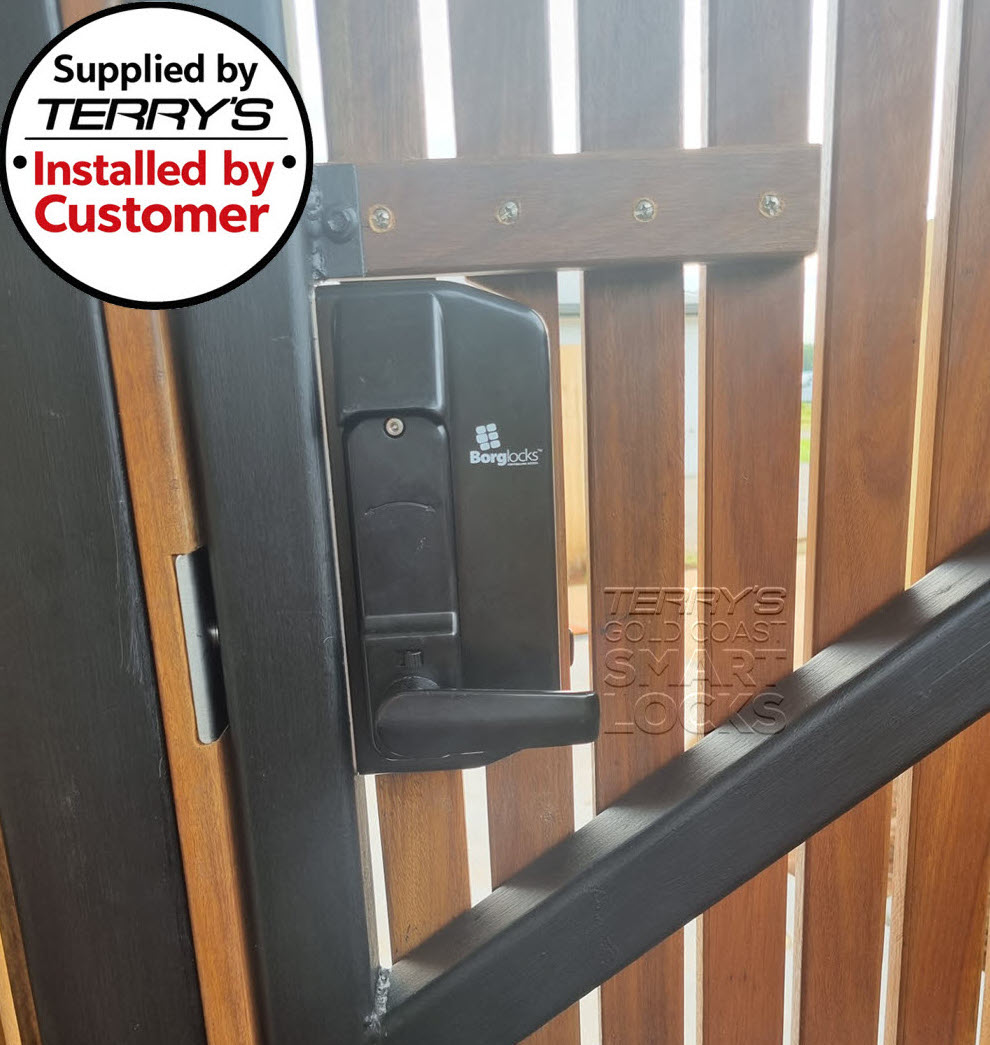
The Borg BL3430 gate lock with back-to-back keypads is the version with a keypad on both sides, so a code is needed to get in and out. There is also a single keypad version with a free-turning inside lever if you only want the code on the outside.
The same style of lock mounted in the field, with the strike fixed to the adjacent post.
The video below shows the forend fixing design used across the Borg BL3000 series — the model pictured is a UK variant, but the fixing method and case shape are shared across the range including the BL3430 and BL3400 above. Watch it rotate through 360° to see how the case wraps the leading edge of the stile from every angle.
Option 3 — prefabricated box mounting
The third route is a purpose-made mounting box — a steel enclosure that fixes to the gate frame and creates the depth the lock needs. Instead of trying to fit the lock inside a narrow section, the box becomes the section. How the box actually fixes to the frame differs by brand, though, and for one of the two options below it rules out aluminium gates altogether.

For the Carbine CDL7 heavy duty series, the Carbine Gate Guard mounting box is the purpose-built answer. The box fixes to the gate frame, the CDL7 keypad and lever mount through it, and the whole assembly reads as part of the gate rather than an add-on.
One of our own installations — a Carbine CDL7 heavy duty lock fitted in the Gate Guard mounting box on a narrow commercial gate.

For the Borg range, BDS make lock boxes that do the same job. The BDS LB21 lock box suits the Borg 2000 series and the BDS LB22 suits the 5000 series, and both take the standard 60mm backset latch.
The outer face of the box becomes the wide stile the latch needs, and where the frame cannot be morticed at all the box is fixed straight on and the lock mounts through it — but the fixing itself is a weld, not a bolt-on bracket. Both boxes are galvanised (zinc plated) steel and are welded directly to the gate frame.
The BDS LB21 lock box, welded to a steel gate frame. The outer face of the box creates the wide stile a standard 60mm latch needs.
Option 4 — get creative
Not every gate matches an off-the-shelf answer. These are the workshop solutions we reach for when nothing above quite fits — backed by the scar plates and spare parts ecosystem that makes them repeatable — and between them they will get almost any lock onto almost any gate.
 Example 1 — a mounting block built from packing plates

A sandwich of plastic packing plates, stacked and fixed to build the mounting surface out to the depth the lock needs. We have these made up for us and cut them to suit the fixtures and the gate we are working on.
It is surprisingly effective. The plates do not corrode, the stack can be shaped around whatever the gate throws at us, and the finished job is far tidier than it sounds.
A Borg back-to-back gate lock mounted on a stack of packing plates that builds out the mounting surface.
Example 2 — use scar plates to bridge the divide

A very common technique on our installs, especially on stiles under 50mm where there is no choice but to move the lock off the main stile. The scar plate spans the gap and carries the lock, spreading the fixing load across more of the frame than the stile alone could offer.
The Borg scar plate pack suits the 2000 and 4000 series keypads, and our guide to scar plates on gates and aluminium doors covers where else these plates earn their keep.
A scar plate bridging a narrow stile so the keypad can mount where the gate alone could not carry it.
Example 3 — modify the gate to take a 60mm latch

The most involved answer is to change the gate rather than the lock. A fabricator adds section to the stile so there is enough depth for a standard 60mm backset latch.
This is more work and generally needs a tradesman, but it has one real advantage: it opens up the entire mechanical digital range rather than the subset that suits a narrow frame. If there is a specific lock you want — a particular finish, a specific access function, a marine grade model — this is how you get it.
A narrow gate stile built out to accept a standard 60mm backset latch.
Which option in practice
If you have no strong preference about the lock itself, the short backset latch is the cheapest and quickest route. If the gate is exposed and you want a purpose-built gate product, the forend system is the more robust answer. A mounting box is the tidy solution for the Carbine CDL7 series on any narrow frame, or for a Borg on a steel frame that cannot be morticed at all — the Borg boxes are welded on, so that route needs a steel gate and a trip to a welder, not an aluminium one. And when nothing off the shelf fits, packing plates, scar plates or modifying the gate will get the lock you actually want onto the gate you actually have.
Wide Stile Gates: The Full Range Opens Up
If the stile is wide enough to take a 60mm backset, the compatibility problem disappears and you are simply choosing the lock you want. Three arrangements account for most of what we see.
100 x 50mm aluminium, mounted sideways

A very common modern arrangement. The section is rectangular rather than square, and the fabricator has turned it so the 100mm dimension runs front to back. That gives ample depth for a standard 60mm latch while keeping the gate looking slim from the front.
A 100 x 50mm aluminium stile mounted sideways gives the depth needed for a standard 60mm backset latch.
Wide timber frames
Timber gates and timber doors are usually built with generous stiles, and solid timber gives you material to bore into rather than a hollow section with thin walls. At 90mm or wider, a standard 60mm backset latch is almost always the right answer.

Frames fabricated to suit a lock

Some gates are built with the lock already in mind. A fabricator adds a plate or housing to the stile specifically to take a keypad and a standard latch. If you are having a gate made, this is worth specifying up front — it costs almost nothing at fabrication stage and removes the whole compatibility question.
A mounting plate fabricated onto the gate stile specifically to carry the lock.
What Fits What
Frame size against lock options
| Gate stile | Typical material | Standard 60mm latch? | What to use instead |
|---|---|---|---|
| 50 x 50mm | Aluminium | No | 28mm short backset latch, forend fixing gate lock, mounting box, or a creative mounting solution |
| 65 x 65mm | Aluminium | No | 28mm short backset latch, forend fixing gate lock, mounting box, or a creative mounting solution |
| 100 x 50mm mounted sideways | Aluminium | Yes | Full range available — choose on function and finish |
| 90mm or wider | Timber | Yes | Full range available — solid material to bore into |
| Fabricated to suit | Steel or aluminium | Yes | Full range available — specify at build stage where possible |
What to Measure Before You Order
Five minutes with a tape measure and a phone camera will settle almost every question on this page.
- Stile width and depth — the vertical member on the opening edge of the gate, where the handle will go
- Material — hollow aluminium section, solid timber, or steel
- Handing — which way the gate opens, and which side you are standing on
- Gap between stile and post — this decides how the strike is packed and whether the latch will reach
- Whether a gate stop is fitted — without one the gate can over-travel and the latch will not engage cleanly

Handing matters on short backset latches
This catches people out regularly. A standard 60mm tubular latch can usually be flipped on site to suit either hand. A 28mm short backset mortice latch cannot — left hand and right hand are separate products with separate part numbers.
Work out the handing before ordering, not after the gate is drilled. Gates are easier to get wrong than doors, because you can approach them from either side.
If you are not certain which hand you have, our guide on how to determine handing walks through it step by step, and which products require handing lists what must be ordered handed. Buyer's Guide Chapter 2 covers handing alongside the other measurements.
Related Guides
How to measure a backset correctly, the standard sizes, and what goes wrong when it is out.
Backset, stile width, door thickness and handing — the measurements every lock choice depends on.
How to determine handing, the four combinations, and which products must be ordered handed.
What scar plates are, when you need one, and the brand-by-brand guide — including gates and aluminium doors.
Another narrow-frame option, and why gate movement causes it trouble over time.
Common fitting mistakes, including wrong backset and strike misalignment.
Not Sure What Will Fit Your Gate?
Send us the stile measurement and a photo of the gate edge, and we will tell you which locks will actually work before you order.
Ask an ExpertVisit Australia’s leading Smart Lock showroom and workshop:
Gold Coast Smart Locks
9/2 Prosper Crescent
Burleigh Heads, QLD
See working models, compare gateways, and get real advice before you commit.