
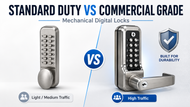
Heavy Duty Commercial Mechanical Digital Locks
Posted by Mat Steele on 9th Jul 2026

Not every keypad lock is built for a door that opens two hundred times a day — here is what actually separates commercial grade from the rest.

Mechanical digital locks are popular because they are simple, reliable and battery-free — enter the correct code, operate the handle, and the door opens. But not all of them are built for the same level of use, and nowhere does the difference matter more than in commercial buildings. A staff door in a busy shop, school, warehouse or strata block may operate hundreds of times a day — and commercial sites bring fire door certification and DDA accessibility requirements that the lock itself must meet. That is where a heavy duty commercial mechanical digital lock becomes important.
This guide covers:
- What "heavy duty" actually means — cycle ratings, internals and clutching
- Matching the lock to commercial door hardware, including mortice conversions
- Fire doors and the certification the lock itself must carry
- The exit-path rules, DDA levers, key override and free passage
- When commercial grade is worth it — and how we replace old keypad locks
If you are new to this style of lock, start with the main guide on how mechanical digital locks work and come back.
A Lockwood DX on a staff-only storeroom door — the classic busy commercial shop fit.
What Does Heavy Duty Actually Mean?
In simple terms, a heavy duty mechanical digital lock is designed for more frequent use, more demanding environments and more robust commercial door hardware.
It is not just a larger version of a basic keypad lock. A true commercial-grade lock has stronger internal components, heavier duty spindle operation, better clutching, stronger latches, key override options, easier code change systems and finishes suited to demanding applications.

High Traffic Changes Everything
The biggest difference between a standard lock and a heavy duty commercial lock is how often it is expected to operate. A residential gate may see light use; a commercial staff entry, school door or warehouse access door is opened constantly — and every use puts wear on the buttons, lever, spindle, latch, internal chamber and fixing points. In high-traffic areas, lighter-duty locks reach their practical limit much sooner.
Cycle ratings put a number on it. Carbine's CDL7 heavy duty series, for example, is cycle tested and exceeds 50,000 openings — the figure is in the CDL7100 specification sheet. On a door opened 100 times a working day, that is roughly two years of constant duty; a light-duty lock offers no such number at all.

Where Are Heavy Duty Locks Usually Used?
Heavy duty mechanical digital locks are chosen for areas where reliability matters and repeated use is guaranteed:
- Commercial staff entry doors, warehouses and workshop access
- Schools and education facilities
- Strata and body corporate utility areas
- Industrial sites, plant rooms and service rooms
- Institutional and government facilities
- High-use internal or sheltered external doors
They are especially useful where you want code access without relying on batteries, apps, wiring or electronic programming — which is most of the list above.
Stronger Internal Components
A heavy duty lock is expected to survive more use, so the internal design matters. Look for stainless steel internal coding chambers, robust button assemblies — hardened stainless ball-bearing buttons on the Carbine range, which also resist the code-revealing wear that soft buttons develop — strong spindle drive, and a mechanism built to cope with the resistance of commercial door hardware.

Better Suited to Commercial Door Hardware
Commercial doors often carry heavier hardware than a residential door — stronger latches, heavier return springs, more substantial lock cases. A commercial-grade keypad lock needs the spindle drive and clutching to match; lighter-duty lever mechanisms may simply not provide enough torque against a heavily sprung commercial case.
This is where the Lockwood DX range earns its position as the workhorse of our commercial fits. The Lockwood 3572DX — the DX keypad paired with the 3572 commercial mortice lock — puts battery-free code access onto a proper commercial mortice case, and the DX conversion kits do the same for existing 3570-series doors. The short backset 3782 conversion is a popular variant for narrower commercial stiles, and a 127mm backset version exists for the rare wide-stile door that needs it.
If the door runs an ANSI mortice case instead, the case function matters before the keypad does — see F05 vs F54 mortice lock functions.
Fire Doors Need Certified Locks
Commercial buildings mean fire doors — and on a fire door, the lock is part of the doorset's fire performance. A mechanical digital lock fitted to a fire door must be fire certified for that use, full stop.
The Carbine heavy duty series is the certified answer in our mech-digi range. The CDL7100 carries a CSIRO Certificate of Assessment for a fire resistance level of −/120/30 on the referenced doorsets, and the CDL7200 carries Warringtonfire assessments to the same −/120/30 level on both its referenced doorset systems. The certificates are published and worth reading before a fire-door job:
- CDL7100 fire certificate (CSIRO)
- CDL7200 fire certification — assessment 1 (Warringtonfire)
- CDL7200 fire certification — assessment 2 (Warringtonfire)

Key Override Can Be Important
Many mechanical digital locks are code-only, which is fine in the right application. In commercial environments, though, a key override gives management, maintenance staff or locksmiths another way in if the code is forgotten, changed incorrectly, or the lock needs to sit within a broader key system.
The Borg BL7701 heavy duty lock builds an SFIC key override directly into the lever handle, allowing the key to physically engage the lever clutch and spindle drive — and SFIC cores slot straight into commercial master key systems.
How override keyways work across the category — and which locks lack them entirely — is covered in mechanical key override explained.
On-Door Code Changing
Code management separates basic from advanced here too. Some models require the lock to come off the door to change the code — acceptable at home, frustrating on a commercial site where staff change and contractors come and go.
Locks with on-door code change, such as Borg's Easicode Pro, change the code while the lock stays installed — about thirty seconds with the change key; the full procedure is in the Borg Easicode Pro code change steps. The three brands' methods are compared side by side in three code change methods compared.
Free Passage Function
Some commercial mechanical digital locks include a free passage function: the lever stays unlocked for a period so users enter without a code each time. Importantly, this is different from holdback — with passage mode the latch keeps working and the door still latches closed.
Useful during business hours and high-movement periods, but it needs managing so the door is not left unsecured unintentionally. The full function guide is passage mode vs holdback mode.

Doors in Required Exit Paths
Commercial buildings are where this rule bites hardest — and it decides the lock's format before anything else on this page does.


The Carbine CDL7200LL with dual BCA levers is the range's purpose-built answer — compliant lever action on both faces, heavy duty internals, and the fire certification covered above.
Carbine CDL7200LL — dual BCA-compliant levers, −/120/30 fire assessed.
DDA and Accessible Levers
Accessibility requirements go a step beyond the exit-path lever rule. On doors serving accessible areas, the lever itself must be operable without a tight grip or fine motor control — which is what AS 1428.1-compliant flat-bar levers are shaped for.

Two answers in the range: the Borg BL5401 DDA with the flat-bar lever built to AS 1428.1, and the Carbine CDL7100SC, which pairs a front knob with a rear DDA disability lever for storeroom-style doors where egress-side accessibility is the requirement.
The accessibility standard itself — what AS 1428.1 asks of door hardware and where it applies — is covered in the AS 1428.1 accessibility section of the Buyer's Guide.
Borg BL5401 DDA in Marine Grade Pro black — the AS 1428.1 flat-bar lever.
Finish and Environment Matter
Commercial does not always mean internal. Some doors face weather, salt air, coastal conditions, UV, dust or harsh industrial environments — and a finish suited to an internal office door is the wrong option for a coastal external one. This is why commercial models are offered in different finishes and marine-grade versions: the BL7701, for example, comes in satin stainless for internal and sheltered use and a Marine Grade Pro black for coastal and harsh external doors.

When Is a Heavy Duty Lock Worth It?
| Standard duty lock | Heavy duty commercial lock | |
|---|---|---|
| Best for | Homes, light-use doors, small offices, lower traffic | High traffic commercial, institutional, industrial and shared access doors |
| Usage level | Light to medium | Medium to heavy and high traffic |
| Internal strength | Suitable for standard applications | Built for demanding operation and a longer service life |
| Key override | May not be included | Often available or built in |
| Code changes | May require lock removal | Often on-door |
| Cost | Lower upfront cost | Costs more upfront, better suited to demanding sites |
One pattern from the workshop is worth knowing: we regularly replace old commercial keypad locks — Unican, NK2000-era Carbine, older Lockwood 530 digitals — and the failure story is almost never the mechanism wearing out. It is a lock asked to do a job it was never suited to: outdoors, or under heavy commercial traffic. So we rarely replace old-for-new like-for-like; we replace with the brand and model that actually suits the use case — the philosophy behind how our mech-digi range is curated. That is the whole argument for buying commercial grade the first time.

The Borg BL7701 shows what the full commercial specification looks like in one product: heavy duty lever/lever operation, SFIC key override in the handle, Easicode Pro on-door code changing, free passage function, a stainless steel coding chamber, a 60mm heavy duty latch with 70mm available, fully mechanical operation, and finish options from internal through to harsh external. Not just keypad access — the lock matched to the usage level, hardware, environment and commercial requirements.
Borg BL7701 — the full commercial specification in one lock, key override in the lever.
Questions to Ask Before Choosing
- How many times per day will the door be used?
- Is the door internal, sheltered external or fully exposed — and is the site coastal?
- Is the door a fire door, in a required exit path, or serving an accessible area?
- Does the lock need a key override, and should it join a master key system?
- Does the code need to change regularly, and is free passage required?
- Is the door timber, composite, steel or commercial aluminium — and what thickness? (how to measure door thickness)
- Is the existing lock case heavily sprung?
- Is the lock replacing an old Unican or similar commercial keypad lock?
These details determine whether a lighter-duty lock is genuinely suitable, or whether a true heavy duty commercial option is the safer choice.
Related Guides
The category explained from the coding chamber out — battery-free keyless entry.
The three brands compared on code changing, corrosion and best use.
What each function does, when to use them, and the one hard exclusion.
Why fire doors have their own rules, and which locks actually comply.
How override keyways work, and which locks go without them.
AS 1905.1 fire doorsets, AS 1428.1 accessibility and the lock grading system.
Need Help Choosing a Commercial Mechanical Digital Lock?
Email a few photos to contact@terrys.team with your name and phone number, and we will match the lock to the door, the traffic and the compliance requirements — before you buy.
Ask an Expert- A photo of the front of the door
- A photo of the edge showing the existing latch or lock case
- The approximate door thickness
- Whether the door is internal, sheltered external or exposed — and whether the site is coastal
- Whether the door is a fire door or in a required exit path
- How often the door is used each day, and whether key override or free passage is required
This helps us recommend a lock that is suitable before you buy.
Disclaimer: This article is general information only. The correct mechanical digital lock depends on your door type, lock case, traffic level, environment, keying requirements, installation conditions and intended use. Fire door and exit path requirements are regulated; always confirm compliance with the relevant certifier before purchasing or installing commercial access hardware.