
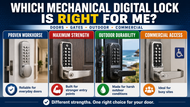
Lockwood vs Borg vs Carbine
Posted by Mat Steele on 9th Jul 2026

Each brand has a place. The right choice depends on whether you need proven reliability, brute-force resistance, corrosion protection, or commercial compliance.
Lockwood, Borg and Carbine all make excellent mechanical digital locks — but they each have their own strengths, suiting different installations. A Lockwood DX is not trying to be the same product as a Borg marine-grade gate lock, and a Borg MG Pro gate lock is not trying to be the same product as a Carbine BCA dual-lever commercial lock. Choosing the right range for the right application is what this guide is for.
This guide covers:
- The one-line answer for each brand, then the detail behind it
- Who is behind each brand — and why locally held parts and support matter
- The Lockwood 530DX and 002DX — and the four 002DX configurations
- Borg MG Pro's outdoor case, and Carbine's commercial compliance case
- How the three code change methods differ, and the honest corrosion numbers
- A best-use comparison table and clear choosing guidance
If you are new to this style of lock, start with the main guide on how mechanical digital locks work and come back.
The Simple Answer
The industry workhorse. The go-to mechanical digital lock for commercial doors for decades — and still the volume leader in our own commercial work.
The brute-force option. A mechanical keypad combined with the famous Lockwood 002 deadlatch body for excellent physical resistance.
The outdoor specialist. Marine-grade coatings, 316 stainless internals and the strongest salt spray numbers in the range.
The commercial compliance option. Heavy duty cycle-tested internals, fire-certified models, BCA lever access and strong commercial value.

Three Brands, Three Stories
The three brands arrive at quality from completely different directions, and knowing who is behind each one explains a lot about how the products behave.

Borg is an independently owned British specialist that has done one thing since 1997: design and build pushbutton locks, with its own engineers, in its own UK factory. Nearly thirty years of that single focus shows in two ways — by far the largest mechanical digital range of the three, running from budget internal locks right through to marine-grade gate hardware, and its signature innovation, the Easicode Pro coding chamber that changes the code while the lock stays on the door.

Carbine is the flagship lock brand of the Davcor Group — a privately held, Australian-owned company that grew from a family-started locksmith supply business in 1985 into one of the largest security hardware distributors in the southern hemisphere, then moved into designing and manufacturing its own products. Carbine locks are developed in collaboration with Australian locksmiths — "Trusted by Locksmiths" is its literal tagline — and several models are manufactured in Australia. Its mechanical digital range is smaller than Borg's, but it is the most commercially credentialed of the three: published fire certification, BCA-compliant levers and DDA options.

Lockwood is the most recognised lock name in Australia, a brand story running back to 1934, and since 2001 fully part of ASSA ABLOY — the world's largest lock group and the same parent company as Yale. That puts global testing regimes and standards compliance behind a deliberately commercial-only mechanical digital range: there is no consumer-level line, and the DX family is built accordingly.

Lockwood 530DX: The Industry Workhorse

The Lockwood 530DX has earned its place through decades in the field. It is simple, familiar, mechanical and practical — and it remains the mechanical digital lock we fit more than any other on commercial doors. For utility rooms, staff doors, service corridors and back-of-house areas, it is the recognisable default for a reason.
It is not the newest or flashiest option, and that is part of the appeal: a proven keypad lockset for sites that want code access without batteries, apps or programming. It is fire-rated where correctly specified — what that specification actually involves is covered in fire doors need certified locks — and the wider DX family extends the same keypad onto commercial mortice cases, covered in suiting commercial door hardware.
A Lockwood DX on a staff-only storeroom door — the classic busy commercial shop fit.

Lockwood 002DX: Brute-Force Resistance

The 002DX takes a different approach. Rather than a standard tubular latch, it combines mechanical keypad access with the Lockwood 002-style deadlatch — one of the most physically resistant lock bodies in Australian hardware. The deadlatching pin means the latch cannot be carded back once the door is closed; what that mechanism does is explained in what self-latching means.
The family comes in four configurations — a knob or a lever handle, in opening-inwards and opening-outwards variants — so the door swing and the handle preference are both catered for. The 002DX with lever for opening-inwards doors is the configuration we fit most, with the knob variant on the same page family.
A Lockwood 002DX on a commercial shopfront's aluminium stile door.
Borg MG Pro: The Outdoor Specialist
Borg MG Pro is where we look first when the lock needs to live outdoors. The range pairs marine-grade external coatings with 316 stainless steel internal components and 1,000-hour salt spray testing — the strongest published corrosion numbers among the three brands.

The Borg BL2601 MG Pro ECP knob is the doors-and-gates all-rounder in the format, and the BL4401 lever gate lock carries the same specification into dedicated gate applications. If the lock is going near the beach, a canal, a waterfront property or anywhere exposed to harsh weather, corrosion resistance becomes one of the most important parts of the decision.
What the MG Pro and ECP names actually promise — and where marine grade genuinely earns its keep — is unpacked in MG Pro & ECP explained.
Borg BL2601 MG Pro ECP on a pedestrian gate — the doors-and-gates all-rounder outdoors.
Carbine CDL7100 & CDL7200: Commercial Compliance and Value
Carbine's heavy duty series is not trying to be a marine-grade gate specialist. Its strength is commercial practicality, and it comes as two distinct models worth naming precisely: the CDL7100, a front knob with a rear BCA lever and a holdback function, and the CDL7200, with BCA-compliant levers and no holdback — the CDL7200LL dual BCA lever being the required-exit-path answer in the mech-digi category.

Both are cycle tested past 50,000 openings, built with hardened stainless ball-bearing buttons, and carry published fire certification — the CDL7100 through CSIRO and the CDL7200 through Warringtonfire, both to −/120/30 on their referenced doorsets. The certificates and how to read them are in fire doors need certified locks. For aged care, medical centres, schools and sites where accessible lever operation matters, Carbine is a very attractive option at a sensible commercial price point.
The full Carbine electronic and mechanical range — and where the CDL7 series sits within it — is mapped in the Carbine CEL & CDL range guide.
Carbine CDL7200LL on a commercial gated entry — BCA-compliant lever access outdoors.
Three Brands, Three Code Change Methods
A practical difference that only shows up after purchase: how each brand changes the code. Borg's Easicode Pro does it on the door with a change key in about thirty seconds. Lockwood's method removes the keypad backplate and re-seats code tumblers — thorough, but a bench job most owners hand to a locksmith. Carbine sits between the two, using rear-of-lock slider combs that reward a careful first attempt.
If codes will change often — staff turnover, contractors, managed properties — this difference alone can decide the brand. The full brand-by-brand procedures are in changing codes on mechanical digital locks. The three methods are compared step by step in three code change methods compared.
Corrosion Resistance, Honestly Compared
Coastal buyers deserve the actual numbers, so here they are. Borg's MG Pro coating is tested to 1,000 hours of neutral salt spray — corresponding to the C10 "Extreme" corrosion classification under AS 4145.2. Carbine publishes 240 hours for its locksets — corresponding to C7 "High" — and puts the figure in writing in its own salt spray testing document. The cycle and construction detail behind the Carbine numbers is in the CDL7100 specification sheet.
Two pieces of honesty to go with the numbers. First, a salt spray chamber is an accelerated laboratory test — hours in the chamber do not translate to years on a gate, and an installed lock's life depends heavily on exposure, rinsing and maintenance. Second, C7 "High" is a genuinely capable rating: for most exposed installations it is entirely adequate, and the C10-class Borg coating earns its premium in the harshest first-row-to-the-ocean positions rather than everywhere. The classifications themselves are explained in the AS 4145 lockset standard, and the full salt-spray story in salt spray hours compared.

Gates Need Extra Care
Brand choice is only part of the decision. Gates create their own problems: they are exposed, they move over time, they often have narrow stiles, and they can sometimes be reached over or through. For many gates the real question is not Lockwood vs Borg vs Carbine — it is whether the lock needs a short backset, a double-sided keypad, or a latch type that tolerates gate movement.
- If the inside handle can be reached: the single-sided gate lock problem
- If the gate stile is narrow: what actually fits a narrow gate stile
- If a magnetic latch is being considered: why gate movement defeats magnetic latches
Access Functions Also Matter
Some mechanical digital locks offer passage mode, holdback mode, key override, or on-door code changing — and the features need to match the site. A passage function may be useful during business hours; holdback can be handy for short-term convenience on a private gate; in shared access areas, free access functions can create security problems if not managed properly.
The features also split along model lines within a brand — the Carbine CDL7100 carries a holdback function while the CDL7200 deliberately does not, which is one reason the CDL7200 is the exit-path and fire-door pick. The functions are explained in passage mode vs holdback mode, and which locks carry a key override — and which go without — in locks without a key override.
Best Use Comparison
| Product / range | Hero strength | Best applications | Watch points |
|---|---|---|---|
| Lockwood 530DX | Proven industry workhorse | Commercial doors, staff access, utility rooms, service corridors | Backplate code change; less specialist for gates |
| Lockwood 002DX | Brute-force resistance | Doors needing a strong deadlatch-style lock | Four configurations — must match handle preference and door swing |
| Borg MG Pro | Corrosion resistance and outdoor performance | External gates, coastal homes, waterfront areas, harsh weather | Correct model, backset and latch choice still matter |
| Carbine CDL7100 / CDL7200 | Commercial compliance and value | Aged care, medical, education, commercial utility doors, accessible lever sites | Not a marine gate specialist; models differ on holdback |
What These Locks Will Not Do
Whichever brand you land on: mechanical digital locks are reliable, battery-free and honest about what they are. They are not smart locks, and it is worth being clear about the trade before you buy.

One more honest point: over years of use the buttons in the code wear and discolour, which narrows the guesswork for anyone paying attention. Changing the code periodically is worth doing for this reason alone — and it is a strong argument for the hardened stainless buttons the quality brands fit.
None of these are faults. They are the trade you accept for a lock that never needs a battery, never loses connection and keeps working through a power outage. If you need per-person access or an audit trail, an electronic lock is the better tool — the full honest comparison is in what mechanical digital locks will not do.
Which One Should You Choose?
- Choose the Lockwood 530DX when you want a proven, familiar mechanical digital lock that has stood the test of time on commercial doors.
- Choose the Lockwood 002DX when you want a stronger deadlatch-style solution with excellent physical resistance, in the configuration that matches your door.
- Choose Borg MG Pro when the lock is going outside, near the coast, on a gate, or into a harsh environment where corrosion resistance leads the decision.
- Choose Carbine CDL7100 or CDL7200 when you need a practical high-volume commercial lock with BCA lever access, fire certification and strong value — the 7200 where exit paths or fire doors are involved.
The best mechanical digital lock is not the strongest, newest or most expensive — it is the one that best matches the door, gate, environment and users.
And a final note on why the range matters: locks can look similar online, but the real difference is in the latch, internal components, finish, spare parts and code-change method. Why we stock these three brands rather than the lookalikes is covered in why our range beats the hardware store imitations.
Related Guides
The category explained from the coding chamber out — battery-free keyless entry.
The complete Carbine digital lock range mapped model by model.
Cycle ratings, fire certification, exit paths and DDA levers explained.
How the two locking formats differ, and which suits your door or gate.
Lockwood, Borg, Carbine and every other brand we fit, profiled in depth.
Need Help Choosing Between Lockwood, Borg and Carbine?
Email a few photos to contact@terrys.team with your name and phone number, and we will recommend the right brand and model for your door or gate — before you buy.
Ask an Expert- A photo of the front of your door or gate
- A photo of the edge showing the existing latch or lock
- Your approximate door thickness and backset, if known
- Whether the lock is for a door, gate, fire door, commercial site or coastal location
- How often the lock is likely to be used each day
This helps us recommend a suitable lock before you buy.
Disclaimer: This article is general information only. The correct mechanical digital lock depends on your door type, gate design, fire-rating requirements, latch preparation, backset, environment, usage level and installation conditions. Always confirm suitability before purchasing or installing hardware.
Blog #4