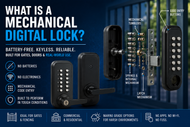
What Is a Mechanical Digital Lock? Battery-Free Keyless Entry Explained
Posted by Mat Steele on 2nd Jun 2026

Battery-free keyless entry explained — no apps, no batteries, no flat-battery lockouts. Just a code and a mechanism.
A mechanical digital lock is a keypad lock that uses a code instead of a key, but does not use electronics, batteries, WiFi, Bluetooth or an app. Enter the correct code and turn the handle, and the latch operates. Enter the wrong code and the lock stays locked.
Everything happens inside a purely mechanical mechanism — which is exactly why these locks have been solving the same problem, largely unchanged, for sixty years.
This guide covers:
- How the mechanism actually works, and what the coding chamber does
- How the codes work — including a detail about code order that surprises most people
- Why these locks suit gates better than almost anything else
- Internal, external and marine grade versions, and how to tell which you need
- An honest account of what these locks will not do
If you are weighing up how the lock should actually secure the door or gate, the companion guide on latch vs bolt mechanical digital locks covers that decision.
How a Mechanical Digital Lock Works
Press the correct buttons and the mechanism lets the handle drive the latch. Press the wrong ones and the handle turns without doing anything — the clutch simply never engages. There is no motor, no solenoid and no circuit board making that decision. It is all springs, tumblers and machined metal.

- No batteries to replace, and no flat-battery lockouts
- No wiring, no smartphone apps, no Bluetooth or WiFi
- No software updates, and no platform that can be discontinued
- Nothing that stops working in a power outage
 Inside the coding chamber
The heart of the lock is the coding chamber — a block of small tumblers, one per button. Each tumbler is set as either part of the code or not. When the buttons matching the code are pressed, all the coding tumblers line up and a clutch engages between the handle and the latch mechanism. Any wrong button pushes a tumbler out of line, and the clutch stays disengaged.

Changing the code means physically re-arranging those tumblers. How easy that is varies a lot by brand — from removing the lock's backplate with tweezers in hand, to sliding tabs on the rear of the keypad, to Borg's Easicode Pro system which does it on the door in about thirty seconds.
The coding chamber opened up — one tumbler sits behind each button, and a single code tumbler (pin) is shown enlarged. Physically re-arranging these pins is how the code is changed.
 Why are they called “digital”?
The word can mislead. Here, “digital” refers to keypad code entry, not electronics — you use your digits to press the buttons. Fancy naming? Maybe. Useful product? Absolutely. You will also see them called mech-digi locks, mechanical keypads, or push-button locks; they are all the same thing.
Sixty Years of the Same Idea
The mechanical digital lock is not a new invention scrambling to keep up with smart locks — it predates them by half a century. The Unican 1800, released in 1965, established the push-button coding chamber design, and the locks sold today work on fundamentally the same principle. Some of those early Unicans are still on doors, still working.
That longevity is the point. A design that has survived sixty years of daily use, weather and abuse without needing electronics is a design with very few ways to fail. When we replace an old push-button lock, it is almost never because the mechanism wore out — it is usually because the lock was asked to do a job it was never suited to, like heavy commercial traffic on a light-duty model. Choosing the right grade for the job matters more than the age of the technology.
How the Codes Actually Work
Here is the detail that surprises almost everyone: on a mechanical digital lock, the code can be entered in any order. If the code is 1346, then 6431 opens the lock too — and so does 4613. The coding chamber only cares which buttons are pressed, not the sequence, because each button simply sets its own tumbler.
Each button can also only be used once in a code — there is one tumbler per button, so a code cannot contain the same digit twice.

One code, shared by everyone. There are no individual user codes on a mechanical lock — the mechanism has one coding chamber, so it has one code. What that means in practice is covered honestly further down.
Why Choose a Mechanical Digital Lock?
Electronic smart locks are great when you need app control, remote access, audit trails or temporary codes. But not every door or gate needs that level of technology — and every added feature is something else that can go flat, drop offline or need an update.
A mechanical digital lock is the right tool when you want:
- Simple keypad access without keys to cut, carry or lose
- Reliable operation, year after year, with nothing to charge
- No app setup, no accounts, no internet or gateway requirements
- A tough lock for repeated everyday use in exposed places
For higher-use commercial doors, the lock needs to match the traffic level — cycle ratings and internal build quality vary enormously across the category. Our guide to heavy duty commercial mechanical digital locks covers what separates a commercial-grade unit from a light-duty one.
Why They Suit Gates
Gates are one of the hardest places to put any lock. They cop rain, sunlight, coastal air, dust, movement, misalignment and daily use — and they are usually a long way from a power point. That is exactly why mechanical digital locks are so popular on gates: with no electronics or batteries inside, there is nothing for the weather to kill.

We fit them constantly on:
- Side access and courtyard gates
- Pool equipment enclosures, pump rooms and plant rooms
- Body corporate and strata gates
- Commercial yards and bin enclosures
- Sporting clubs and schools
One of our own installations — a Borg keypad lock on a decorative metal gate, mounted on a scar plate where the stile alone could not carry it.

Gate installations need extra care in two specific ways. If someone can reach over, through or around the gate to work the inside handle, a double-sided digital mechanical lock with a keypad on both faces is the smarter option. And if the gate frame is narrow — especially the common 50 x 50mm aluminium section — the standard latch will not physically fit; our guide on what to do when the gate post is too narrow for a 60mm latch walks through all four workable answers.
For a broader view of which lock types suit which doors and gates, the Buyer's Guide compatibility matrix covers all nine door types.
Internal, External and Marine Grade Options
Not all mechanical digital locks are built for the same environment. Some models are intended for internal doors, others suit sheltered external positions, and specialist products are designed specifically for gates and fully exposed outdoor locations.
A lock that performs perfectly on an internal office door can corrode into uselessness on a coastal gate inside two years. The difference is in the coating and the internal materials, not the mechanism — which is why the same basic lock is often sold in several environmental grades.

Mech-Digi Locks We Trust at Terry's
Three locks that show the breadth of the category — a commercial door workhorse, a purpose-built gate lock, and a heavy duty unit built for compliance-critical doors.


 Lockwood 002DX mechanical digital deadlatch
A heavy-duty mechanical keypad deadlatch and the biggest seller in the category — commonly fitted to commercial doors, offices, storerooms and shared access areas. Available in knob and lever versions for both inward and outward opening doors. Best suited to commercial doors, staff access doors and high-use internal or protected entry points. View the Lockwood 002DX with lever for inward opening doors.
Borg BL4401 MG Pro ECP gate lock
A purpose-built mechanical keypad gate lock from Borg's Marine Grade Pro range, designed for tough outdoor applications — with the on-door Easicode Pro code change system. Best suited to side gates, commercial gates, coastal properties and exposed outdoor installations. View the Borg BL4401MGPROECP gate lock.
Carbine CDL7200 heavy duty
Carbine's heavy duty line, with hardened stainless ball-bearing buttons, a 50,000+ cycle rating, fire certification to −/120/30 on referenced doorsets, and BCA-compliant levers for doors where a knob is not permitted. Best suited to commercial doors, fire doors and exit-path doors where compliance decides the hardware. View the Carbine CDL7200LL heavy duty dual lever.
For a proper head-to-head of the three brands — code change methods, corrosion ratings and best use per model — see Lockwood vs Borg vs Carbine mechanical digital locks.
Changing the Code: Brand by Brand
Because the code lives in the mechanism, changing it is a physical job — and how physical varies enormously by brand. The short version:


The full three-brand comparison — methods, time and where each lands — is in three code change methods compared, and the brand shootout covers it in three brands, three code change methods. For the full step-by-step procedures for every brand, see how to change the code on a mechanical digital lock.
Mechanical Digital Lock vs Smart Lock
Neither is “better” — they are different tools. The honest comparison:
| Feature | Mechanical digital lock | Electronic smart lock |
|---|---|---|
 Batteries required Batteries required |
No | Usually yes |
 App control and remote access App control and remote access |
No | Often available |
| Individual user codes and audit trail |
No — one shared code | Usually yes |
| Works through a power outage or flat battery |
Always | Depends on model and backup |
| Suits exposed gates |
Yes, with the correct grade | Extremely limited — effectively one product, the McGrath Ascot |
 Best for Best for |
Simple, reliable keypad access | App features, remote access, user management |
If you are leaning electronic, it pays to go in with clear eyes: our guide to what actually fails on electronic door locks covers batteries, coastal conditions and door alignment honestly, and the common types of electronic door lock maps that side of the market.
Common Gate Latch Problems
Choosing the keypad is only half the decision. The latch or bolt behind it has to suit the gate, the frame, the strike and the way the gate actually hangs — and this is where most gate lock trouble starts.
The most common issue we see: the gate frame is too narrow for the standard 60mm backset latch the lock ships with. On a 50 x 50mm aluminium section the standard latch is geometrically impossible, not just tight. The full set of answers — short backset latches, forend fixing gate locks, mounting boxes and workshop solutions — is in our guide to narrow stile gates and what actually fits them.
The second recurring problem is the mortice magnetic latch. Useful in tight spaces on paper, but if the gate sags or the post moves even slightly, the pin stops lining up with the striker and the gate stops latching reliably. We explain why — and what we fit instead — in why magnetic gate latches can be problematic.
What These Locks Will Not Do
Mechanical digital locks are reliable, battery-free and honest about what they are. They are not smart locks, and it is worth being clear about the trade before you buy.

The combination space is also smaller than it looks. A Lockwood code uses four to six digits with each digit usable only once; Borg publishes over 4,000 combinations for its layout. And because a code opens the lock in any order — 1346 and 6431 are the same code — the effective pool of codes is smaller again than an electronic keypad's ordered PIN.
That is what makes button wear the point worth taking seriously. Over years of use the buttons in the code wear and discolour, which narrows the guesswork for anyone paying attention — and on a lock where order does not matter, knowing which four buttons are in the code is most of the way to opening it. Changing the code periodically is worth doing for this reason alone, and it is a strong argument for hardened stainless buttons over the soft materials on budget locks.
None of these are faults. They are the trade you accept for a lock that never needs a battery, never loses connection and keeps working through a power outage. If you need per-person access or an audit trail, an electronic lock is the better tool.
Frequently Asked Questions
 Do mechanical digital locks need batteries?
No. They operate mechanically and do not require batteries or electrical power of any kind.
Can the code really be entered in any order?
Yes. The coding chamber only registers which buttons are pressed, not their sequence — 1346 and 6431 open the same lock. Each button can also only be used once in a code.
Can mechanical digital locks be used outside?
Some can, but not all. Gates, coastal areas and exposed locations need an external or marine grade product — on Borg models that is what MG Pro means, explained fully in MG Pro and ECP explained.
Are mechanical digital locks the same as smart locks?
No. A smart lock has electronics, batteries and app-based features. A mechanical digital lock provides keypad access with no electronics at all.
Are they good for gates?
Yes — often the best option, especially where reliability and weather resistance matter more than app control. But the gate model, latch, backset and access direction must be selected carefully, and pool barrier gates have their own rules covered above.
What is the difference between a latch and a bolt version?
A latch suits regular access where the door or gate should latch itself as it closes. A bolt is more deliberate and is thrown and withdrawn by hand. The full comparison is in latch vs bolt mechanical digital locks.
What is the difference between passage mode and holdback mode?
Passage mode allows free access while the latch keeps working; holdback physically holds the latch retracted, so the door or gate no longer latches while it is engaged — which is why holdback has hard exclusions on fire doors and pool barrier gates. The full guide is passage mode vs holdback mode.
Are professional mechanical digital locks better than hardware store versions?
For light-duty internal use, a cheaper lock can be acceptable. For gates, commercial doors, coastal environments and high-use applications, a professional-grade lock is usually the better choice — we explain exactly why in why our range is better than hardware store imitations.
Related Guides
How the two locking formats differ, and which suits your door or gate.
The four workable answers for narrow aluminium gate frames.
What each function does, when to use them, and the two hard exclusions.
The three brands compared on code changing, corrosion and best use.
Which locks suit gates, aluminium frames, narrow stiles and screen doors.
Not Sure Which Mechanical Digital Lock You Need?
The right lock depends on the door or gate, the environment, the latch type and how it needs to operate. Email photos to contact@terrys.team with your name and phone number, and we will recommend what actually fits before you order.
Ask an ExpertVisit Australia’s leading Smart Lock showroom and workshop:
Gold Coast Smart Locks
9/2 Prosper Crescent
Burleigh Heads, QLD
See working models, compare gateways, and get real advice before you commit.