Regular Front Door (one side facing weather)
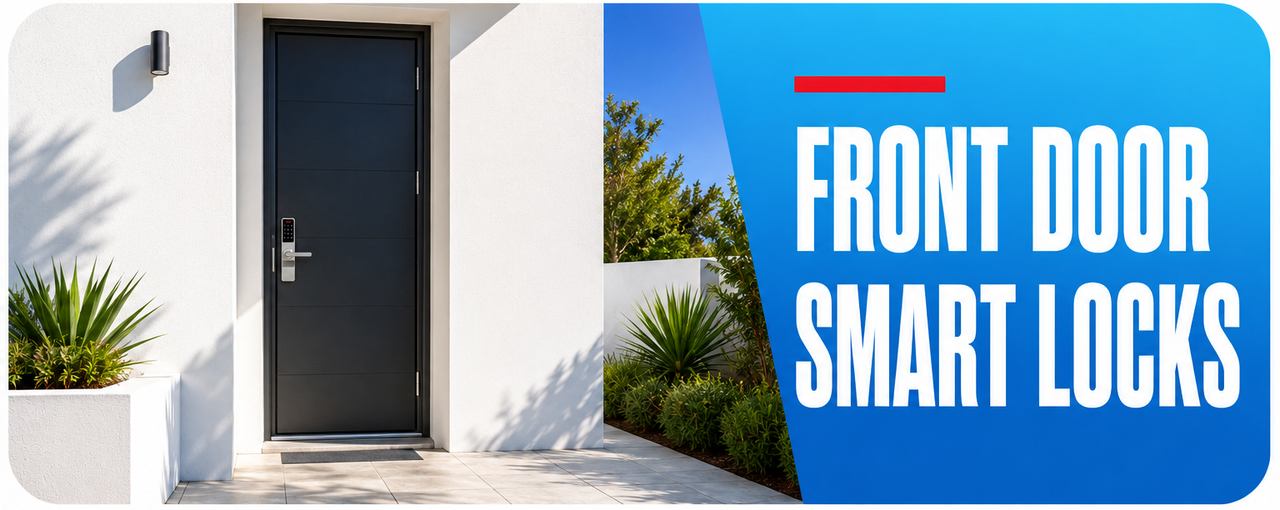
The standard case: a hinged entry door with the outer face exposed to weather and the inner face protected. This is the format with the widest product choice, so the decision moves away from what will fit and onto backset, bolt type, access method and how much weather the outer escutcheon actually sees.
 Fit specifications
 Deadbolt or lever?
- Deadbolt format - replaces or supplements the existing deadbolt. Strong positive locking, and the handle stays as it is.
- Lever or handle set - integrated escutcheon with the lever, replacing the entire entrance set. Cleaner appearance, more preparation work.
- Retrofit deadbolt - the outside cylinder is untouched and the smart mechanism mounts inside. Keeps existing keys working.
- Mortice format - the smart furniture drives a separate mortice body. Common on heavier and commercial-grade doors.

Even on a covered porch, the outer escutcheon takes wind-driven rain. IP55 or better is worth the small premium here, and it matters more within a few kilometres of the coast. Coastal environments and lock life.
 Before ordering
- Measure the backset. This is the single most common ordering error.
- Check the door leaf is not warped or dropped. A misaligned strike will make any smart lock feel faulty.
- Decide whether the existing key should keep working, which points to a retrofit format.
- Confirm whether a security screen sits in front, which changes the answer entirely.
 Related categories
Security Screen Doors · Smart Locks With Backup Key · WiFi Smart Locks · Tubular Latches and Bolts
 Common questions
How do I measure backset?
Measure from the edge of the door to the centre of the existing cylinder or spindle hole. In Australia this is normally 60 mm or 70 mm. Step by step.
Measure from the edge of the door to the centre of the existing cylinder or spindle hole. In Australia this is normally 60 mm or 70 mm. Step by step.
Can I keep my existing keys?
With a retrofit format, yes. The outside cylinder stays in place and the smart mechanism replaces the inside thumbturn only. A full replacement set will come with new keys, which can often be keyed alike to your existing system.
With a retrofit format, yes. The outside cylinder stays in place and the smart mechanism replaces the inside thumbturn only. A full replacement set will come with new keys, which can often be keyed alike to your existing system.
My door sticks in summer. Will that affect a smart lock?
Yes, significantly. A motorised bolt driving into a misaligned strike draws far more current and will report jams or fail to lock. Fix the alignment first. Misalignment and how to correct it.
Yes, significantly. A motorised bolt driving into a misaligned strike draws far more current and will report jams or fail to lock. Fix the alignment first. Misalignment and how to correct it.
 Guides and reference
Ch 02 - Backset and door thickness · Ch 01 - Deadbolts and deadlatches · Bolt throw and projection · Common installation mistakes